


How Teak Magic Compares to Traditional Two-Part Teak Cleaners
Two-part teak cleaners that rely on sodium hydroxide and hydrochloric acid have been the marine industry’s standard for decades. Teak Magic was built as a non-hazardous, more efficient alternative for boat owners who want the same restoration results without that industrial-acid chemistry. Here’s how Teak Magic compares to traditional two-part systems — on hazard profile, environmental impact, metals compatibility, and how far each gallon of concentrate goes.
The short answer
Both categories use the same operating principle — a high-pH cleaner followed by a low-pH brightener. That pH chemistry is what restores teak. What differs is what’s in the bottle creating that pH. Traditional two-part systems use sodium hydroxide (industrial caustic soda) and hydrochloric acid (industrial mineral acid). Teak Magic uses proprietary FDA-GRAS (Generally Recognized As Safe) ingredients that meet food-grade safety definitions. Result: comparable teak-cleaning and brightening outcomes through the same two-step alkaline/acid process, but with a materially different hazard profile and a much larger coverage area.
Try Teak Magic Today
Teak Magic is available as a 32 oz kit or gallons. Both ship free and leave the warehouse the same or next day.
Shop Teak MagicIt’s not the pH. It’s what’s making the pH.
Every effective two-part teak cleaner on the market works similarly: a strongly alkaline cleaner opens the grain and lifts trapped grime, then a strongly acidic brightener restores the natural color and removes mineral staining. Traditional systems and Teak Magic both do exactly that:
| Part 1 (Cleaner) | Part 2 (Brightener) | |
|---|---|---|
| Traditional two-part systems | pH ~13–14 | pH ~1 |
| Teak Magic | pH 14 | pH < 1 |
The pH is the mechanism. You can’t clean and brighten teak without it. What changes the safety story is what kind of molecule is delivering that pH.
What’s in each bottle
Traditional two-part systems (industry standard)
- Part 1 (Cleaner): typically built around sodium hydroxide (CAS 1310-73-2) — industrial caustic soda. Concentrations vary by brand, commonly 2–13% by weight.
- Part 2 (Brightener): typically built around hydrochloric acid (CAS 7647-01-0) — an industrial mineral acid. Concentrations are commonly up to 8% by weight.
- Other common kit ingredients include ethoxylated alcohol surfactants, polyethylene glycol, and synthetic colorants.
Teak Magic
Per the Teak Magic Safety Data Sheet, both Part 1 and Part 2 use proprietary ingredients that meet the FDA federal regulation 21 CFR 170.3 definitions as GRAS (Generally Recognized As Safe) — the same regulatory bar applied to food ingredients. The SDS describes both parts as a “Non-Hazardous Organic Compound.”
Specifically, Teak Magic contains none of the industrial mineral acids or caustics commonly found in traditional two-part teak cleaning systems:
- No hydrochloric acid (HCl)
- No sulfuric acid (H2SO4)
- No oxalic acid
- No phosphoric acid (H3PO4)
- No sodium hydroxide (NaOH)
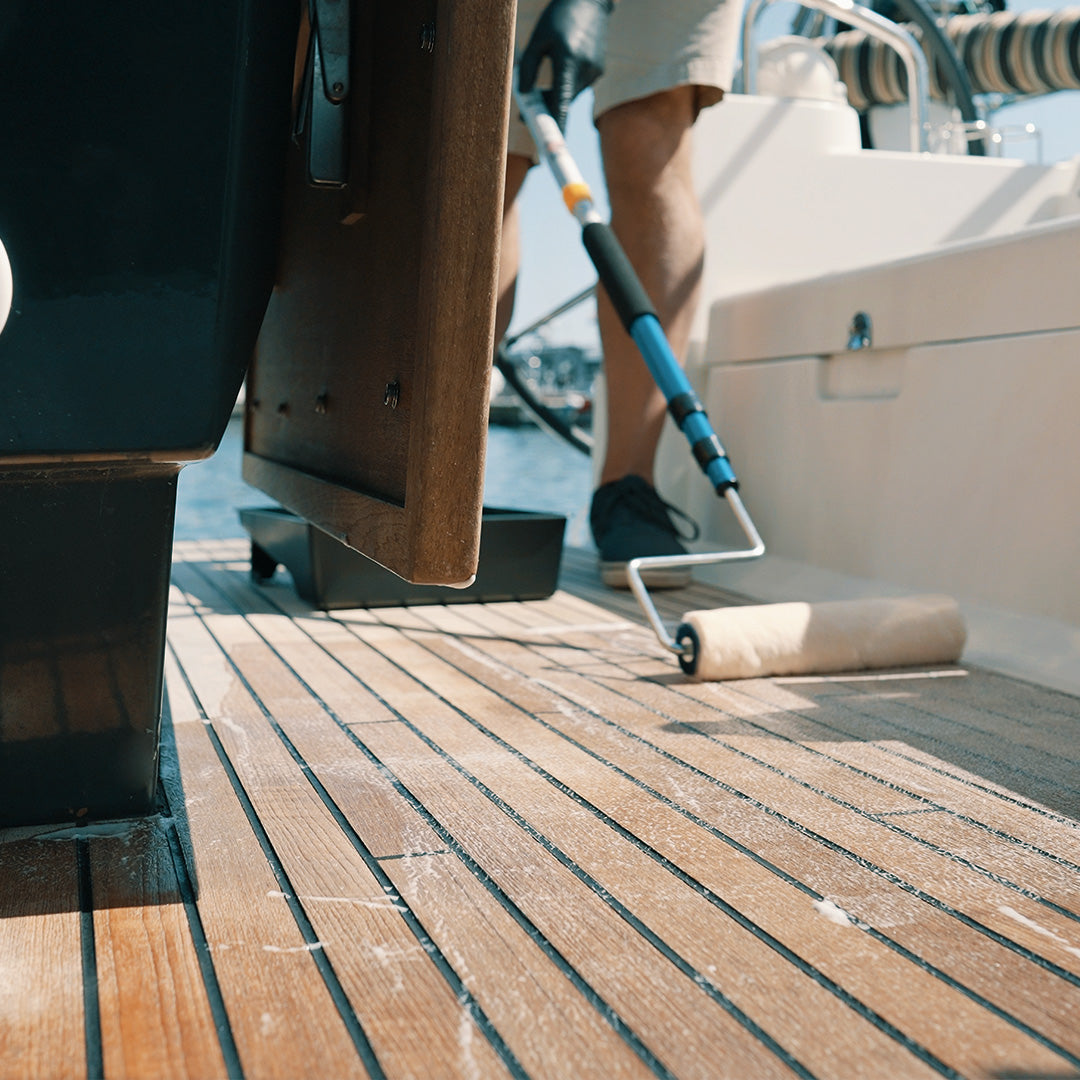
Teak Magic also ships in a gel form (Step 1 baby blue, Step 2 pink) rather than liquid. The gel formulation helps the product to adhere to vertical and overhead surfaces without running off as much as purely liquid formulations.
Hazard profile
This is where the difference between industrial chemistry and FDA-GRAS chemistry shows up. Sodium hydroxide and hydrochloric acid are both well-characterized industrial chemicals with documented regulatory profiles under EPA, OSHA, NIOSH, and DOT — regardless of which brand is selling them.
Sodium hydroxide (the active in most Part 1 cleaners)
- GHS classification: Skin Corr. 1A, Eye Dam. 1, Met. Corr. 1 — signal word DANGER. (Skin Corr. 1A is the most severe skin-corrosion category.)
- Hazard statement H314: “Causes severe skin burns and eye damage.” Direct eye contact can cause blindness.
- DOT/IMDG/IATA transport: UN 1824 SODIUM HYDROXIDE SOLUTION, Class 8 Corrosive, Packing Group II.
- Listed on the EPA CERCLA Hazardous Substance list with a Reportable Quantity (RQ) of 1,000 lb.
- Listed on right-to-know lists in Massachusetts, New Jersey, and Pennsylvania.
- NIOSH-recommended PPE for handling: chemical-resistant gloves, chemical safety goggles, face shield, and corrosion-proof clothing.
Hydrochloric acid (the active in most Part 2 brighteners)
- GHS classification: Skin Corr. 1B, Eye Dam. 1, STOT SE 3 — signal word DANGER.
- Hazard statement H314: “Causes severe skin burns and eye damage.”
- Flagged on California’s Toxic Air Contaminant list and the California Non-Cancer Hazard list.
- Listed on regulated-chemical or right-to-know lists in over 35 US states, including California (SCAQMD), Massachusetts (Right to Know and Toxics Use Reduction Act), New Jersey (Special Health Hazards Substances), and Pennsylvania.
- DOT/IMDG/IATA transport: UN 1789 HYDROCHLORIC ACID, Class 8 Corrosive. Vessel stowage often restricted to “on deck only” on cargo and passenger vessels.
- NFPA Health Hazard rating: 3 — “short exposure could cause serious temporary or residual injury.”
- NIOSH-recommended PPE for handling: chemical-resistant gloves, chemical splash goggles, face shield, and corrosion-proof clothing.
Teak Magic (both parts)
Per the Teak Magic Safety Data Sheet:
- CLP classification: Not Classified. No hazard symbols allocated, no signal word, no hazard statements.
- HMIS rating: Health 0 / Flammability 0 / Physical Hazard 0 — the lowest hazard tier across all three.
- Potential health effects: “May cause eye/skin/respiratory irritation. Low hazard for usual industrial handling.”
- PPE: “Respiratory Protection: Not normally required. Normal ventilation is generally adequate. Safety glasses or goggles are suggested for use.”
- Transport classification across DOT, Canadian TDG, IMO, and IATA: Not Regulated as a Hazardous Material.
In practical terms: traditional two-part teak cleaners are built around chemicals that federal regulators classify as Class 8 corrosives, with the gloves, eye protection, and protective clothing those classifications require. Teak Magic is built around chemicals that meet food-grade safety definitions and requires safety glasses or goggles. The same teak gets cleaned at the end.
Environmental profile
On biodegradability, the two categories aren’t directly comparable. Sodium hydroxide and hydrochloric acid are inorganic substances — biodegradability doesn’t apply in the conventional sense. They neutralize and dissociate, but at use concentration they shift the pH of the surrounding water, which is what creates the aquatic risk. Teak Magic’s SDS, by contrast, documents Hach Reactor Digestion test results concluding 100% biodegradability of its organic ingredient base.
Where the two categories diverge most sharply is on water discharge:
| Traditional two-part systems | Teak Magic | |
|---|---|---|
| Aquatic-organism risk | Both sodium hydroxide and hydrochloric acid are flagged for aquatic toxicity driven by the pH shift they cause. Hydrochloric acid is documented as harmful to aquatic life at low single-digit mg/L concentrations. Wash-down water typically needs to be neutralized before disposal, not rinsed into the water around the boat. | “Safe to discharge into water at both full concentrate or with wash water without harming the marine environment.” |
| MARPOL Annex compliance | Not addressed at the active-ingredient level. | “Fully compliant with the standards of MARPOL Annex III and MARPOL Annex V.” |
| NPDES compliance | Not addressed. | Claimed on the DiTEC product page. |
Metals compatibility
This one is straightforward chemistry. Sodium hydroxide aggressively attacks aluminum, magnesium, zinc, and tin. Hydrochloric acid attacks most common metals including steel, especially at the concentrations used in teak brighteners. Traditional two-part systems carry the metals restrictions you’d expect from those active ingredients.
Teak Magic, despite using a high-pH Part 1 and very-low-pH Part 2, warns against contact with only the soft metals aluminum and brass. It also explicitly confirms it’s “safe on most finished metals, including almost all grades of stainless steel” per the DiTEC product page.
In short: less metals exposure to worry about — most notably an affirmative answer on stainless steel, the metal you’ll most often have around your boat’s teak.
Coverage, dilution, and cost
This is where the gel formula and higher concentration ratio show up on your wallet. Both categories are applied diluted:
| Traditional two-part systems | Teak Magic | |
|---|---|---|
| Recommended dilution ratio | Undiluted (heavy) to 1:4 (light) | 1:4 standard, 1:6–1:8 light cleaning |
| Coverage per gallon of concentrate (heavy clean) | ~75–135 sq ft | ~800–1,000 sq ft |
| Coverage per gallon of concentrate (light/routine clean) | ~600–800 sq ft | ~1,200–1,400 sq ft |
| Coverage per quart of concentrate (heavy clean) | ~25–34 sq ft | ~200–250 sq ft |
A gallon of Teak Magic concentrate cleans roughly 6× to 10× more area than a gallon of concentrate from a typical traditional two-part system. If you’re comparing cost per square foot of cleaned teak, that’s the number that matters — not the shelf price.
Side-by-side at a glance
| Factor | Traditional two-part systems | Teak Magic |
|---|---|---|
| Format | Two-part liquid | Two-part gel |
| Part 1 active | Sodium hydroxide (industrial caustic) | FDA-GRAS proprietary ingredient |
| Part 2 active | Hydrochloric acid (industrial mineral acid) | FDA-GRAS proprietary ingredient |
| GHS classification | Part 1 active: Skin Corr. 1A, Eye Dam. 1, Met. Corr. 1 — DANGER. Part 2 active: Skin Corr. 1B, Eye Dam. 1, STOT SE 3 — DANGER. | Not Classified. No hazard symbols, no signal word. |
| Hazard language | “Causes severe skin burns and eye damage” (H314); risk of permanent corneal damage and blindness from direct eye contact | “Low hazard for usual industrial handling” |
| Required PPE | Chemical-resistant gloves, chemical splash goggles, face shield, corrosion-proof clothing | Safety glasses or goggles |
| Transport classification | UN 1824 / UN 1789, Class 8 Corrosive; vessel stowage often “on deck only” | Not regulated as a hazardous material (DOT, TDG, IMO, IATA) |
| Metals to avoid | Aluminum, magnesium, zinc, tin (Part 1); most metals including steel (Part 2) | Aluminum, brass. Safe on stainless steel. |
| Aquatic discharge | Wash-down water typically needs neutralization; pH shift documented as harmful to aquatic life | “Safe to discharge into water at both full concentrate or with wash water” |
| MARPOL Annex compliance | Not addressed | Annex III & V (per Teak Magic Statement of Compliance) |
| Dilution | Undiluted to 1:4 | 1:4 (1:6–1:8 light cleaning) |
| Coverage per gallon of concentrate | ~75–135 sq ft | ~800–1,400 sq ft |
Which is right for you?
Stick with a traditional two-part system if…
- You’ve used one for years and your current process — PPE, metals precautions, and disposal habits — works for you.
- You’re comfortable handling a Class 8 corrosive (sodium hydroxide and/or hydrochloric acid) and have the gloves, eye protection, and protective clothing the chemistry requires.
Switch to Teak Magic if…
- You want the same restoration result without industrial caustic or mineral-acid chemistry in the bottle.
- You want a gel formulation that helps the product adhere to non-horizontal surfaces.
- You want significantly better coverage per gallon of concentrate.
- You want chemistry built from FDA-GRAS (Generally Recognized As Safe) ingredients, with explicit MARPOL Annex III & V compliance and a manufacturer statement that the product is safe to discharge into water at full concentrate.
Ready to try Teak Magic?
Teak Magic is available as a 32 oz kit or gallons. Both ship free on orders over $75. For the full step-by-step routine, see our step-by-step guide to using Teak Magic.
Shop Teak MagicDisclaimer. This comparison reflects the well-documented regulatory profiles of sodium hydroxide and hydrochloric acid — the active ingredients in most traditional two-part marine teak cleaners — compared against the Teak Magic Safety Data Sheet and product page. Specific products vary by manufacturer and formulation; we recommend reviewing the current SDS and product documentation for any specific product you are considering before use.
Sources cited:
- DiTEC Marine Products, LLC, Safety Data Sheet, Teak Magic Part 1 (Alkaline), Revision Date 1/9/23.
- DiTEC Marine Products, LLC, Safety Data Sheet, Teak Magic Part 2 (Acid), Revision Date 1/9/23.
- DiTEC Marine Products, Teak Magic Cleaner & Brightener product page.
- US EPA CAMEO Chemicals database entries for sodium hydroxide (CAS 1310-73-2) and hydrochloric acid (CAS 7647-01-0).
- NIOSH Pocket Guide to Chemical Hazards entries for sodium hydroxide and hydrochloric acid.
- New Jersey Department of Health Hazardous Substance Fact Sheets for sodium hydroxide and hydrochloric acid.
- US DOT Hazardous Materials Table (49 CFR 172.101) classifications for UN 1824 and UN 1789.